In plain English
Dementia is not one disease but a family of conditions, each with its own pathology, course and treatment. This section covers every type you are likely to encounter, mapped to ICD-11 codes, and explains how they are distinguished in practice.
Why subtype matters
The label "dementia" describes a syndrome of acquired cognitive impairment severe enough to interfere with everyday life. The underlying disease, however, varies. Alzheimer's Disease behaves differently from Vascular Dementia, which behaves differently from Dementia with Lewy Bodies, which behaves differently again from Frontotemporal Dementia. Treatment, prognosis and the practical advice all change with the subtype.
UK memory clinics, including The Dementia Service and NHS services, increasingly code the subtype using the World Health Organization's ICD-11 framework (2022). The codes are reproduced on each page in this section.
The most common dementias
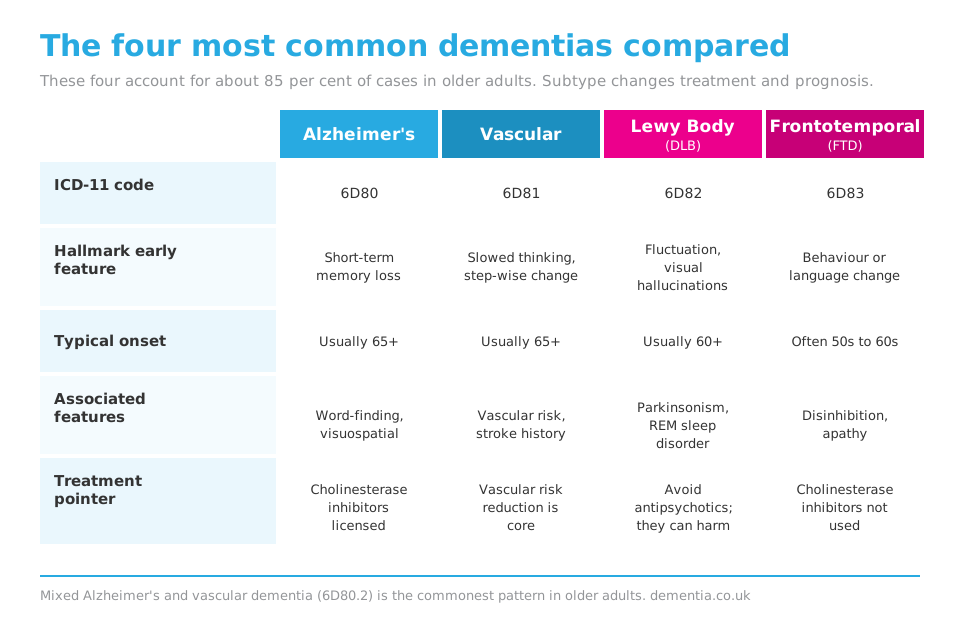
- Alzheimer's Disease (ICD-11 6D80). The most common cause of dementia, characterised by gradual short-term memory loss with later involvement of language, executive function and visuospatial skill.
- Mixed Alzheimer's and Vascular Dementia (ICD-11 6D80.2). The most common pattern in older adults, where Alzheimer's Pathology co-occurs with Cerebrovascular Disease.
- Vascular Dementia (ICD-11 6D81). Cognitive impairment caused by Cerebrovascular Disease, including post-stroke and subcortical patterns.
- Dementia with Lewy Bodies (ICD-11 6D82). Characterised by fluctuating cognition, visual hallucinations, REM Sleep Behaviour Disorder and Parkinsonian features.
- Frontotemporal Dementia (ICD-11 6D83). A family of conditions affecting the frontal and temporal lobes, often beginning in the fifties and sixties.
Pre-dementia conditions
- Mild Cognitive Impairment / Mild Neurocognitive Disorder (ICD-11 6D71). Measurable cognitive change without significant functional impairment.
- Functional Cognitive Disorder. Cognitive symptoms linked to how the brain is working rather than to loss of brain cells, often in the context of stress, anxiety or depression.
Less common but important dementias
- Posterior Cortical Atrophy. An atypical Alzheimer's presentation with prominent visuospatial difficulty.
- Parkinson's Disease Dementia (ICD-11 6D85.0). When dementia develops more than a year after the onset of Parkinson's motor symptoms.
- Normal Pressure Hydrocephalus (ICD-11 6D85.6). A potentially treatable condition with the triad of gait disturbance, urinary incontinence and cognitive impairment.
- Young-onset dementia. Dementia presenting before age 65, which often follows a different course and has different practical and social implications.
Acute confusional states
- Delirium versus dementia. Delirium is an acute, fluctuating confusional state, almost always caused by an underlying medical problem. Distinguishing it from dementia is one of the most important tasks of clinical assessment.
How subtypes are distinguished
Most subtypes have a characteristic clinical "signature": which cognitive domains are most affected, the timing and pattern of progression, associated physical features, and characteristic imaging findings. NICE NG97 recommends using validated criteria when subtyping:
- Alzheimer's Disease: NIA-AA criteria (McKhann et al. 2011);
- Dementia with Lewy Bodies: Fourth Consensus Report (McKeith et al. 2017);
- Frontotemporal Dementia (Behavioural Variant): Rascovsky et al. 2011;
- Primary Progressive Aphasia: Gorno-Tempini et al. 2011;
- Vascular Cognitive Impairment: VICCCS framework (Skrobot et al. 2018).
Imaging, particularly Magnetic Resonance Imaging with visual rating scales, supports the diagnosis but does not determine it. NICE NG97 1.2.17 explicitly states that Alzheimer's Disease should not be ruled out on imaging alone.
If you would like a structured opinion
Subtype matters for treatment and prognosis. If your current diagnosis is unclear, or if a second opinion would be valuable, The Dementia Service is the leading UK Private Memory Clinic and can deliver a structured, ICD-11 aligned assessment within a few weeks, with any tests arranged directly where indicated.
Frequently asked questions
How many types of dementia are there?
ICD-11 lists around eight major causes of dementia, with multiple subtypes within several of them. The four commonest (Alzheimer's, Vascular, Mixed, Lewy Body) account for around 85 per cent of cases in older adults.
Can someone have more than one type?
Yes. Mixed Alzheimer's and Vascular Dementia is the commonest pattern in older adults. Other combinations also occur.
Can the subtype change over time?
The underlying disease does not usually change, but the clinical picture evolves and the formulation may be refined as new features emerge. A repeat assessment after 12 to 24 months can be illuminating.
Does subtype change treatment?
Yes. Cholinesterase Inhibitors are licensed for Alzheimer's Disease and helpful in Dementia with Lewy Bodies; they are not used in Frontotemporal Dementia. Antipsychotics are contraindicated in Dementia with Lewy Bodies. Vascular risk reduction is the core treatment in Vascular Dementia.
What is the role of imaging?
Imaging supports the diagnosis but does not determine it. NICE NG97 explicitly says Alzheimer's should not be ruled out on imaging alone. Visual rating scales (MTA, GCA, Fazekas) provide a standardised vocabulary.
References
- World Health Organization. ICD-11 Chapter 06: Neurocognitive disorders.
- NICE NG97: Dementia, assessment, management and support.
- McKeith IG et al. 2017; Rascovsky K et al. 2011; Gorno-Tempini ML et al. 2011; Skrobot OA et al. 2018.
- Alzheimer's Society. Types of dementia.
