In plain English
The ACE-III is the most widely used cognitive test in UK memory clinics. It takes 15 to 20 minutes, covers five cognitive domains, and gives a score out of 100. This page explains the structure, the standard cut-offs, and what the pattern of scores can tell you.
What the ACE-III is
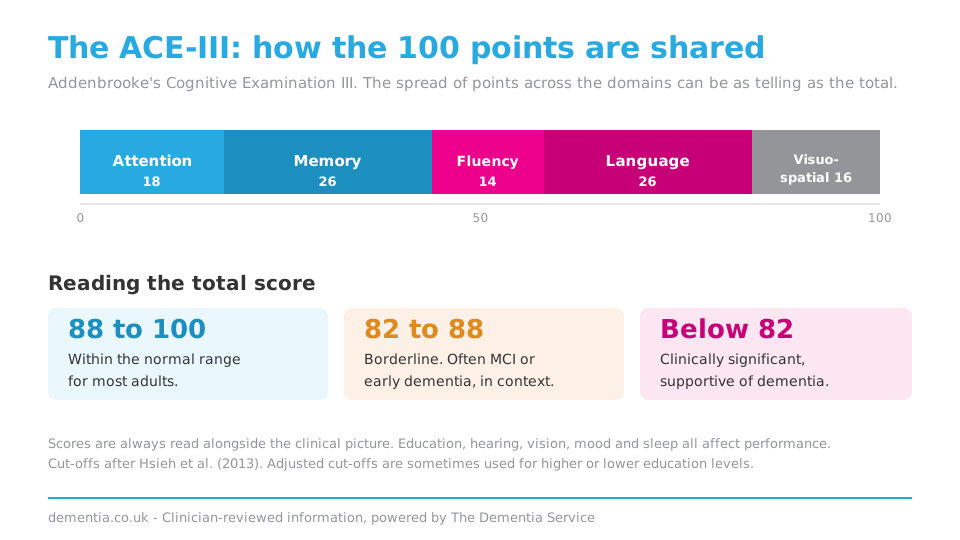
The Addenbrooke's Cognitive Examination, third edition (ACE-III), is a pencil-and-paper test developed at the University of Cambridge. It is the most widely used structured cognitive assessment in UK memory clinics, used by NHS and private services including The Dementia Service. The ACE-III covers five domains: Attention, Memory, Fluency, Language and Visuospatial. The total score is out of 100.
The test typically takes 15 to 20 minutes and can be administered face to face or, with appropriate adaptation, by remote video.
The five domains, explained
Attention (out of 18)
Includes orientation (day, date, month, year, season, country, county, town, street, building or floor), three-word repetition (lemon, key, ball), and a serial-7s or word-spelling task. Attention is often the first domain to be affected in Delirium and Vascular Cognitive Impairment.
Memory (out of 26)
Includes recall of the three words after a short delay, learning of a name and address (Harry Barnes, 73 Orchard Close, Kingsbridge, Devon, repeated three times), recall of the name and address after several minutes, recognition of forgotten items from a list, and recall of famous figures. Memory is typically the most affected domain in Alzheimer's Disease.
Fluency (out of 14)
Two timed minutes: one for words starting with the letter P (letter fluency), one for animals (category fluency). Fluency is often the earliest sign of Frontotemporal Dementia variants and is highly sensitive to vascular changes.
Language (out of 26)
Includes following multi-step commands, writing two complete sentences, repeating short phrases, naming twelve illustrations, defining four less common items, comprehension of pointing tasks, and reading irregular words. Marked language difficulty in the absence of comparable memory loss raises the question of Primary Progressive Aphasia.
Visuospatial (out of 16)
Includes copying overlapping pentagons and a wire cube, drawing a clock face with the time set to 10 past 5, counting dots, and identifying fragmented letters. Visuospatial impairment is prominent in Lewy Body Dementia and Posterior Cortical Atrophy.
How to read your total score
The widely used cut-offs (Hsieh et al., 2013) are:
- Total score 88 to 100: within the normal range for most adults.
- Total score 82 to 88: a borderline range, often reflecting MCI or early dementia, requiring interpretation in clinical context.
- Total score below 82: a clinically significant impairment, supportive of dementia in the appropriate clinical context.
An adjusted cut-off of 88 is sometimes used in higher-education populations, and 82 in older or less educated populations. The most important rule is that scores must be interpreted alongside the clinical picture: a low score in a person with reversible factors (depression, Sleep Apnoea, B12 deficiency) does not by itself diagnose dementia.
For a fuller guide to the cut-offs, each domain score and what can lower a result, see ACE-III scoring and cut-offs explained.
What the pattern reveals
The split of points across the five domains can be as informative as the total.
- Disproportionate memory loss (memory 10/26 to 18/26 with relatively preserved other domains) is the classic Alzheimer's pattern.
- Fluency-predominant decline (fluency 0/14 to 8/14 with preserved memory) raises Non-fluent Variant Primary Progressive Aphasia.
- Mixed attention and memory loss with relatively preserved language and visuospatial domains can fit Vascular Cognitive Impairment or Delirium.
- Visuospatial-predominant deficit raises Posterior Cortical Atrophy or Lewy Body Dementia.
These are starting points, not certainties. A clinician integrates the ACE-III with history, examination, blood tests, ECG and imaging to arrive at the diagnosis.
Reading the score in context
Several factors influence ACE-III performance and should be considered:
- Education and language. Performance is affected by years of formal education, English-language background, and any history of dyslexia or learning difficulty.
- Hearing and vision. Uncorrected hearing or vision impairment substantially reduces the score, particularly in the attention and language subdomains.
- Mood and anxiety. Depression and anxiety reduce ACE-III scores, sometimes by ten or more points; treatment of the mood disorder often improves the score on retest.
- Sleep, recent illness and medication. Acute illness, poor sleep, alcohol, anticholinergic medicines and recent surgery all reduce performance.
The Mini-ACE
The Mini-ACE is a five-minute screening version with a maximum of 30. It is useful when the full ACE-III is not tolerated, such as in severe impairment or limited consultation time. A Mini-ACE score below 21/30 is suggestive of cognitive impairment requiring further assessment.
How the ACE-III is used in your care plan
The ACE-III gives a baseline against which future assessments can be compared. A typical UK care plan includes:
- A baseline ACE-III at the first assessment;
- A repeat at 6 to 12 months if cognition is stable, sooner if symptoms change;
- Annual review thereafter, with adjustment for treatment effect.
For MCI, the trajectory of ACE-III over time is one of the most useful clinical indicators of stability versus progression.
What the ACE-III cannot do
The ACE-III is a screening test, not a diagnosis. It does not:
- Confirm Alzheimer's or any other specific subtype;
- Predict the rate of future decline with precision;
- Replace neuropsychometric testing for complex differential diagnoses.
For complex cases, particularly young-onset or atypical presentations, formal neuropsychometric assessment by a clinical psychologist provides a much fuller cognitive profile.
What to expect on the day
You will be asked questions, asked to repeat short lists, and given some short writing and drawing tasks. There is no need to revise; the test is designed to measure usual cognitive functioning. Wear hearing aids and glasses as normal. If you would like a family member to be present, ask in advance. If the test becomes distressing, you can pause or stop at any time.
Frequently asked questions
How long does the ACE-III take?
About 15 to 20 minutes for the full test, or 5 minutes for the Mini-ACE.
What is a normal score?
Scores of 88 to 100 are within the normal range for most adults. Scores of 82 to 88 are borderline, and below 82 is supportive of dementia in the right clinical context.
Can I prepare for the ACE-III?
No formal preparation is helpful or recommended. Rest well, take usual medications, bring hearing aids and glasses.
What happens if my score drops on repeat testing?
A reproducible drop of around 4 to 5 points or more, in the absence of reversible factors, is clinically meaningful and prompts review of the diagnosis and management.
Can the ACE-III be done remotely?
Yes. A modified version is well validated for video assessment when face-to-face testing is impractical, with some specific adaptations (for example, the writing and drawing tasks).
What is the difference between ACE-III and MMSE?
The Mini Mental State Examination (MMSE) is shorter (out of 30) and less sensitive to early or atypical dementia. The ACE-III is the UK standard and gives a richer cognitive profile.
References
- Hsieh S, Schubert S, Hoon C, Mioshi E, Hodges JR. Validation of the Addenbrooke's Cognitive Examination III in Frontotemporal Dementia and Alzheimer's Disease. Dementia and Geriatric Cognitive Disorders 2013;36(3-4):242-50.
- Mioshi E, Dawson K, Mitchell J, Arnold R, Hodges JR. The Addenbrooke's Cognitive Examination Revised (ACE-R): a brief cognitive test battery for dementia screening. Int J Geriatr Psychiatry 2006.
- National Institute for Health and Care Excellence. NG97: Dementia, assessment, management and support.
- Hsieh S et al. The Mini-Addenbrooke's Cognitive Examination: A new assessment tool. Dementia and Geriatric Cognitive Disorders 2015.
